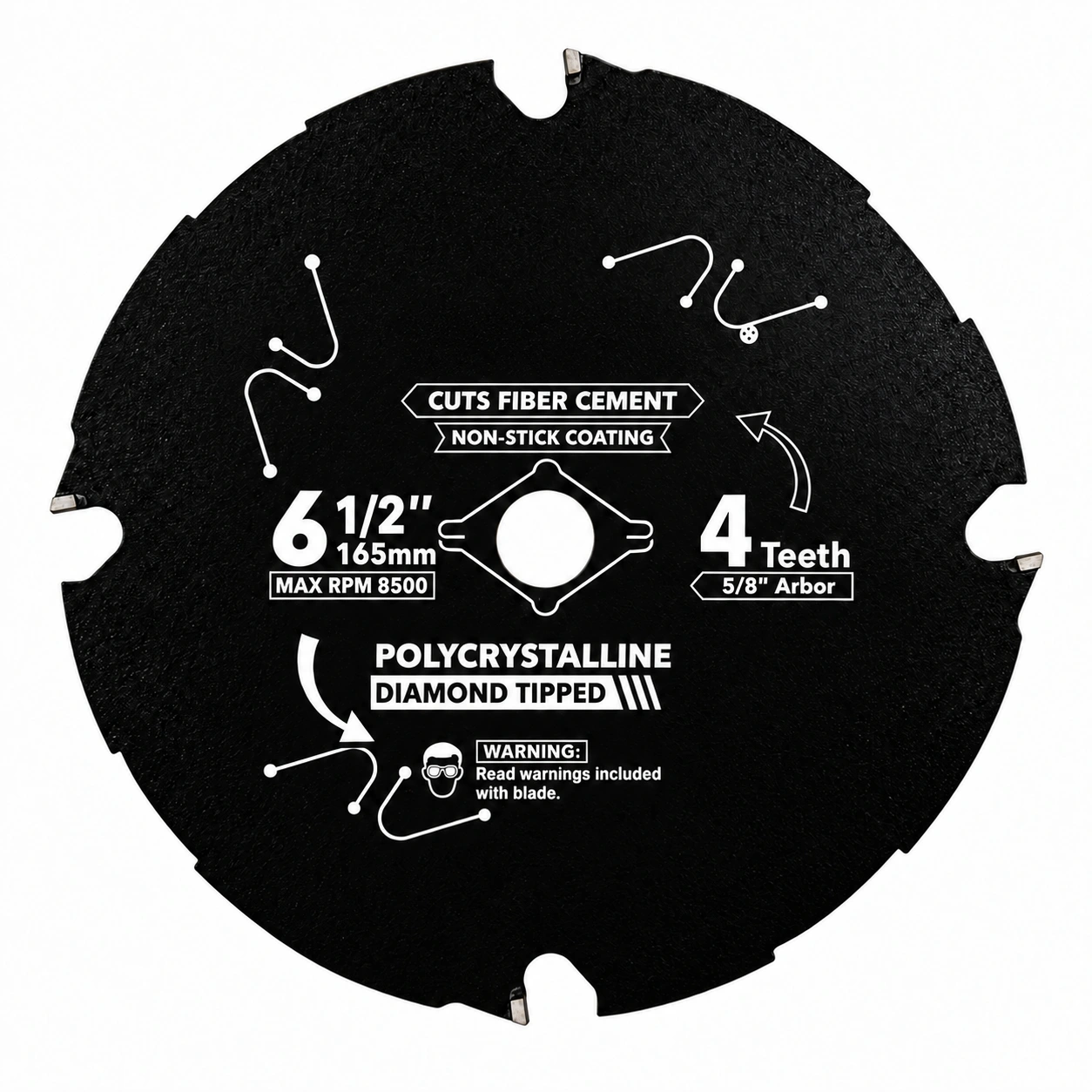
165 mm PCD Fiber Cement Blade — 4T
6½-inch blade with a 5/8-inch arbor, four PCD teeth and an 8,500 maximum RPM rating. Specify for the corresponding approved saw size.
Source PCD fiber cement saw blades for contractor supply and industrial cutting, with four diameter configurations and defined arbor, tooth-count and speed-limit combinations for clear product selection.
A fiber cement blade must match both the board being cut and the saw carrying it. Compare the complete blade configuration before selecting quantities, so the blade specified fits the approved equipment and cutting task.
Start with the blade sizes used by your contractor, building-material or industrial customers. The four options below are complete configurations. A common fiber cement application does not make different diameters interchangeable, even where their arbor sizes match.
6½-inch blade with a 5/8-inch arbor, four PCD teeth and an 8,500 maximum RPM rating. Specify for the corresponding approved saw size.
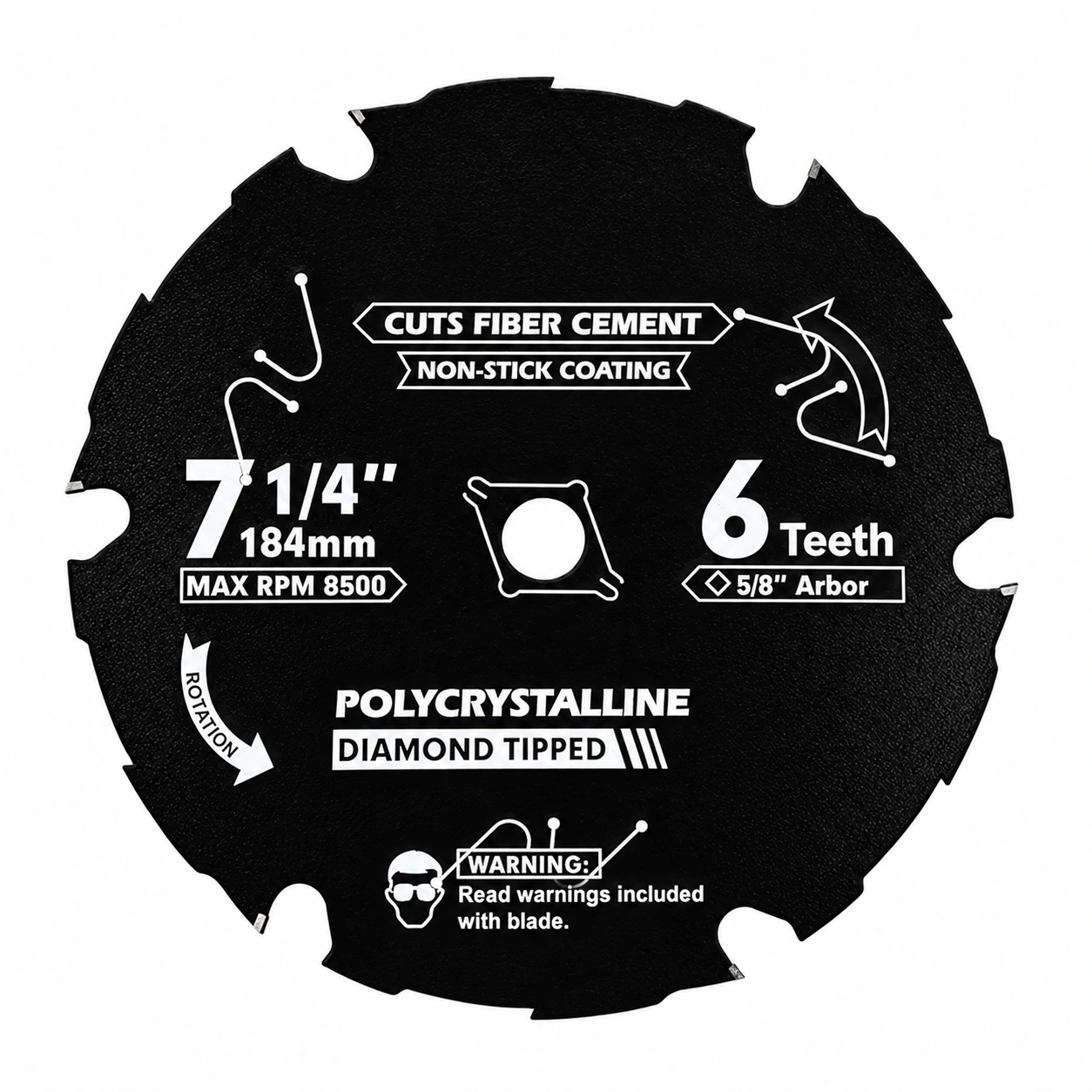
7¼-inch blade with a 5/8-inch arbor, six PCD teeth and an 8,500 maximum RPM rating. A separate configuration from the 165 mm blade.
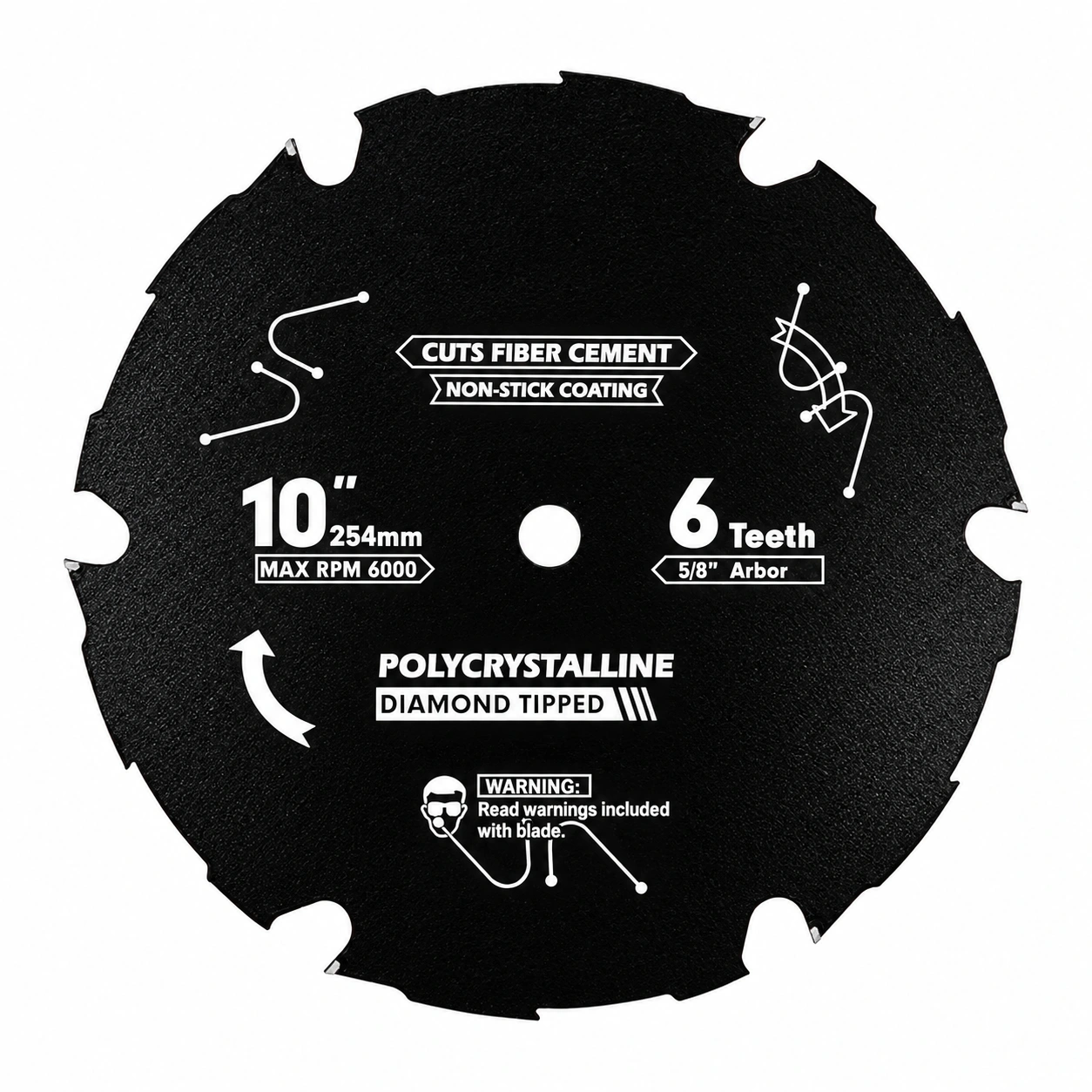
10-inch blade with a 5/8-inch arbor, six PCD teeth and a 6,000 maximum RPM rating. Select for an approved 254 mm machine setup.
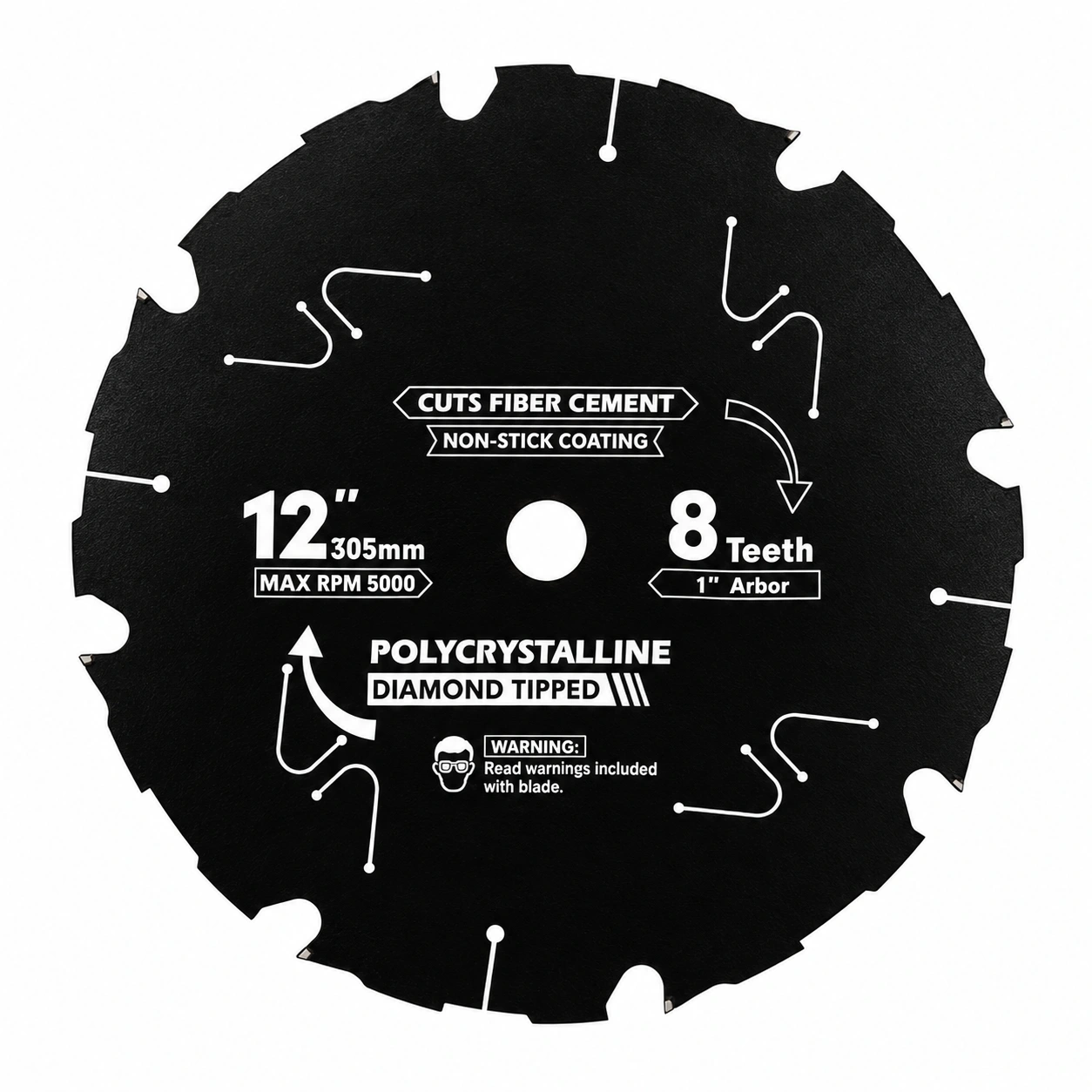
12-inch blade with a 1-inch arbor, eight PCD teeth and a 5,000 maximum RPM rating. Keep its mounting requirement separate from the smaller sizes.
For a replacement order, send the full description of the blade currently used, together with the saw model. For a new distribution line, identify the diameter requirements of the customer groups you plan to supply. This gives the quotation a practical starting point without adding sizes your customers cannot use.
Request Pricing by Size and Quantity
Use the same four fields when comparing a fiber cement saw blade across quotations: diameter, arbor, teeth and maximum blade speed. The combinations in this table stay together; the range is not a menu of freely interchangeable bores or tooth counts.
| Blade Diameter | Nominal Inch Size | Arbor | Teeth | Maximum Blade RPM |
|---|---|---|---|---|
| 165 mm | 6½ in | 5/8 in | 4T | 8,500 |
| 184 mm | 7¼ in | 5/8 in | 6T | 8,500 |
| 254 mm | 10 in | 5/8 in | 6T | 6,000 |
| 305 mm | 12 in | 1 in | 8T | 5,000 |
Maximum RPM is the blade's speed limit, not a recommended operating setting. Use the machine manufacturer's permitted blade and speed requirements when assessing a configuration. A higher number on a smaller blade does not apply to the 254 mm or 305 mm versions.
Keep inch bores precise in your purchase specification. A 5/8-inch arbor is 15.875 mm; it is not an alternative way to write 16 mm. The 1-inch bore is 25.4 mm. Retaining the original inch designation also avoids a rounded conversion reaching your purchase order or customer listing.
Polycrystalline diamond forms the cutting tips of these blades for the fiber cement application.
Open spaces between teeth distinguish the cutting layout from a continuous-rim masonry diamond disc.
Four, six and eight teeth form distinct layouts, each paired with its specified blade diameter.
The bore locates the blade on the matching saw arbor with the machine's approved mounting components.
A polycrystalline diamond fiber cement blade gives your buyers a clearly defined product category: a toothed circular blade with PCD cutting tips for fiber cement. Keep that description on the inquiry, quotation and customer-facing pack. A generic request for a “diamond blade” could also refer to a masonry disc, while a similar-looking circular blade may use carbide. Identifying the cutting material and application early keeps the product discussion focused on the blade your customer needs.
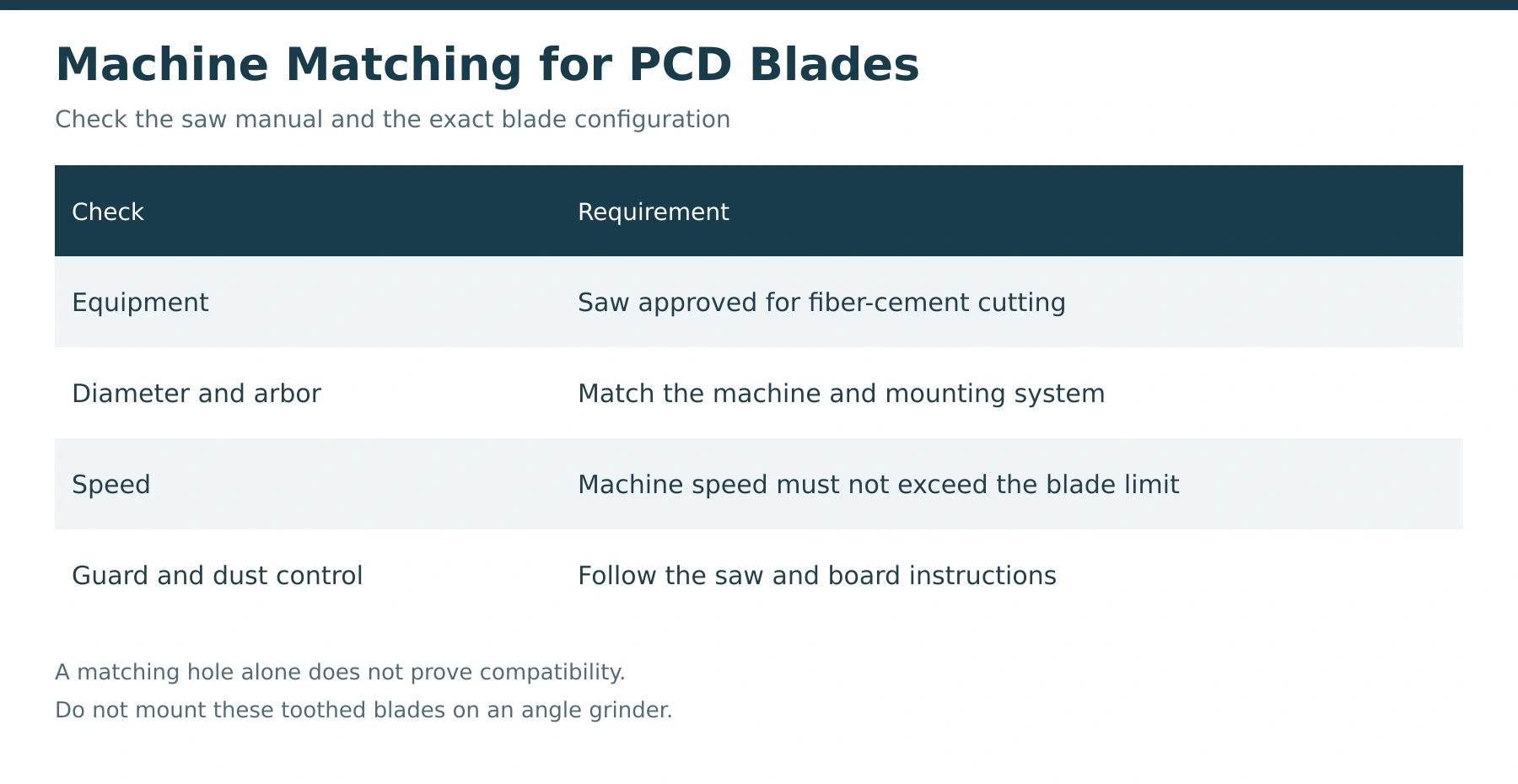
A fiber cement blade for circular saw use needs more than a familiar diameter. Match the exact saw model, permitted blade type, bore, mounting arrangement and speed rating as one selection. This applies to portable and stationary equipment alike. For distributors serving several saw platforms, the machine model is a useful field on each customer inquiry; it prevents a shared inch-size description from concealing a different mounting or application requirement.
| Customer Equipment Detail | Purchasing Decision |
|---|---|
| Permitted material and blade type | Establish that the saw manufacturer allows fiber cement cutting with the selected toothed blade. |
| Required diameter | Select 165, 184, 254 or 305 mm to match the approved machine specification. |
| Arbor and mounting system | Match the exact bore, flanges and fastening arrangement, including only expressly approved adapters. |
| Machine speed | Keep the saw within the selected blade's maximum RPM and the tool manufacturer's requirements. |
| Guarding and dust collection | Assess the complete cutting setup under the board and tool manufacturers' instructions. |
These toothed blades are not for angle grinders. An abrasive cut-off machine is not established as suitable merely by a matching bore. Fiber cement dust also requires the appropriate control method; a blade alone does not make a cutting system dust-free. Keep these equipment conditions in the selection discussion rather than treating nominal size as universal compatibility.
Your customers may buy the same blade category for different finished parts. Describe the board product and cutting task when requesting samples or a volume quotation. The required edge, board section and approved saw determine what needs evaluation; blade diameter alone does not establish board thickness or stacking capacity.
A fiber cement siding saw blade serves contractors cutting boards to installation lengths. Supply the exact board brand, profile and thickness with the inquiry, especially where a visible end or corner affects acceptance. Select the PCD configuration that fits the approved saw, then evaluate breakout on that siding product. A trial on a flat panel does not automatically answer the requirements of a different siding profile.
Panel cutting calls for attention to the finished edge and the customer’s actual sizing operation. Identify whether the cut edge will remain visible, be covered by a joint detail or receive further finishing. Pair the approved saw with its required blade configuration and assess the chosen panel. This ties sample approval to the finished component instead of accepting a blade on the basis of material name alone.
Trim orders may involve narrow pieces, corners and short finished sections where edge loss is commercially significant. Ask for the trim product and representative cut requirements when selecting the blade for evaluation. The useful result is an acceptable component on the intended equipment. A larger blade is not automatically preferable; the diameter must still follow the machine specification and the customer's cutting arrangement.
For customers cutting recurring board orders, define the material, section and finished-edge requirement as a repeatable purchasing application. Single-board cutting and stacked-board cutting are separate conditions. Any stack arrangement needs express approval under the board, blade and machine instructions before evaluation. Specify the actual arrangement rather than estimating capacity from blade diameter, and keep it attached to the accepted sample reference.
Other cementitious or composite boards need their own material assessment. Calcium silicate, fire-resistant, decorative and composite panels can differ in composition. Send the product identification and cutting guidance for a separate selection discussion rather than extending fiber cement suitability to every board described as a composite.
A useful quotation comparison begins with the same product. “7¼-inch cement board blade” leaves the cutting material, bore, teeth and maximum RPM unresolved. Use the complete configuration and application so a lower price does not conceal a different blade. PCD and carbide-tipped fiber cement blades are separate product types and should remain separately identified in your purchasing comparison.
| Comparison Field | Basis for a Useful Buying Decision |
|---|---|
| Blade identity | Compare PCD-tipped blades with PCD-tipped blades; identify a carbide alternative separately. |
| Physical configuration | Match diameter, arbor and tooth count before treating offers as equivalent. |
| Speed rating | Retain the maximum RPM attached to that exact configuration. |
| Workpiece | Use the same fiber cement product, thickness, profile and surface finish. |
| Cutting result | Agree acceptable edge chipping, breakout and straightness for the finished component. |
| Sample conditions | Relate the comparison to the same approved saw and cutting arrangement. |
| Commercial quantity | Compare the quantity allocation by size and the required pack format. |
| Cost basis | Compare cost against acceptable cutting output in the buyer's application. |
PCD is used in blades for abrasive material cutting, but the material name alone does not establish how many boards a blade will cut. Board formulation, blade geometry and the cutting setup affect the result. Evaluate a PCD-versus-carbide proposal against the work your customer actually accepts, without assuming a universal service-life multiplier or a fixed cost saving.
Tooth count deserves the same care. The 165 mm 4T, 184 mm 6T, 254 mm 6T and 305 mm 8T options also differ in diameter. They are not an isolated trial of four, six and eight teeth on an otherwise identical blade. More teeth do not automatically mean a better fiber cement edge. Start with machine fit, then assess the complete configuration on the selected board.
Kerf and plate thickness are different selection fields: kerf is the width removed by the cutting teeth, while plate thickness is the body thickness behind them. Where your production setup depends on those dimensions, include the current blade drawing or specification with the inquiry. This is particularly relevant to a guided setup or a machine with a riving knife. Neither dimension can be established reliably from a product photograph.
For an importer or wholesaler, the right assortment follows the equipment and purchase demand of the customer base. Allocate each configuration to the machines and applications it will serve.
Separate the customers you intend to serve: siding contractors buying for portable saws, panel processors replacing a specified blade, and building-material distributors replenishing an established local assortment. Ask each group for its saw models and current blade references. Use those requirements to allocate quantities by diameter rather than starting with an equal split across four sizes.
An inquiry can cover one configuration or a proposed mix. List the quantity for each selected size so the discussion addresses the actual order. If you are introducing a new line, distinguish initial evaluation quantities from the intended commercial requirement and state the destination. Your size mix, application and pack requirements then form a coherent sourcing brief, rather than a request for a single price covering unlike blades.
Discuss Your Required Size Mix
Sample approval should answer a commercial question: will this configuration produce the finished work your customer accepts? Describe that acceptance before comparing blades. A concealed panel edge, a visible siding end and a narrow trim component may have different allowable breakout. The relevant standard is the customer's component, not an unrelated demonstration cut.
Include the following in your sample request:
Keep the approved equipment and dust-control arrangement consistent during the buyer's evaluation. Compare photographs and finished pieces at a useful scale, and separate acceptable output from rejected work when discussing value. If board type or cutting conditions change, record the change before interpreting it as a difference in blade performance.
Retain the accepted blade description and sample result with your purchase specification. This gives both sides a concrete reference for the commercial order. It does not replace the machine or board manufacturer's instructions, and it does not imply that a result on one fiber cement product applies to every board sold under that category.
Include your packing requirements in the quotation request so the discussion covers the product as you intend to receive and sell it. Single-blade retail presentation and grouped industrial supply can have different handling and labeling needs. Specify the intended pack quantity and how the blades need to be separated and protected, particularly around the PCD cutting tips.
For retail or distributor packs, provide the required application wording, diameter, arbor, tooth count and maximum RPM. State any barcode, item number, language and artwork requirements. Keep “PCD fiber cement saw blade” distinct from carbide blades and related composite-cutting products. The pack identification should follow the blade selected for that item, including its exact bore designation.
For industrial orders, describe the inner-pack quantity, blade separation and carton identification your receiving team needs. If several configurations will be purchased together, identify each line separately so a 305 mm 1-inch-arbor blade is not grouped under the same item description as a smaller 5/8-inch-arbor version.
Send branding or private-label packaging requests with the technical and quantity brief for assessment. State the desired format instead of assuming a standard pack, printing service or branding arrangement. Any agreed packing specification should be included with the commercial offer and retained with its artwork revision. This keeps the accepted presentation tied to the actual order.
A reorder should identify the complete accepted product, not rely only on “fiber cement blade” or a nominal inch size. Retain diameter, arbor, PCD tip identification, tooth count and maximum RPM in the item specification. Add the board application, reference sample and agreed packing description so purchasing, receiving and sales teams work from the same selection.
Where a replacement is proposed, compare it with that accepted reference. A change in bore, cutting material or tooth count deserves a new product discussion even if the diameter is unchanged. A new board formulation or a different customer saw also changes the application being supplied. Treat those changes explicitly rather than carrying forward the earlier sample result without review.
For each repeat inquiry, send the required quantity by configuration, destination and required receiving date. Include the accepted specification reference and any packing revision. Your required date is an input to the quotation discussion; availability and delivery terms belong in the order-specific offer. This gives the next purchase a clear basis while leaving changes visible before an order is agreed.
Compare application fit, equipment compatibility and the supply configuration when preparing your purchasing requirement.
Compare diameter and arbor as a matched configuration. Check the blade speed limit against the saw before adding a size to your purchasing range.
Identify the fiber cement board and cutting task in the inquiry. Keep the application separate from unrelated wood, metal or general masonry cutting requirements.
List quantities against each selected blade configuration. Add sample and packing requirements to the same specification for a like-for-like quotation.
Select a blade intended for the specific fiber cement product and approved saw. These AXIMET configurations use PCD tips and are identified for fiber cement. A timber blade or masonry diamond disc is a different product. For distribution, retain the fiber cement application and PCD identification in the item description so customers can distinguish the blade before checking diameter, arbor and speed.
Tooth count alone does not rank the result. Here, the four-tooth blade is 165 mm, the six-tooth blades are 184 mm and 254 mm, and the eight-tooth blade is 305 mm. Select the configuration required by the approved saw, then compare its result on the intended board. Include kerf or plate requirements in the inquiry where those dimensions govern an established production setup.
The four configurations are identified for fiber cement. That does not establish suitability for timber, plastic decking or every composite panel. PCD is a cutting-material description, not universal material approval. If your assortment also needs wood or composite-cutting blades, identify the specific material and application separately. Keep those products distinct in the quotation and customer listing rather than extending the fiber cement description.
A 5/8-inch bore is 15.875 mm, not exactly 16 mm. Use the bore and mounting arrangement required by the saw manufacturer, with only expressly approved mounting components. The 305 mm blade has a separate 1-inch bore. Send the machine model when replacing an existing blade; diameter, permitted blade type, mounting and speed must all fit the intended setup.
Only where the complete arrangement is expressly permitted by the board, blade and machine instructions. Stacking changes the combined thickness, support and dust-control requirements; single-board suitability does not establish a stacking capacity. Describe the proposed board arrangement in your inquiry and sample criteria. Do not assign a maximum board thickness or number of layers from the blade diameter alone.
Send the configuration and quantity by size, fiber cement product and thickness, saw model and destination. Add the required receiving date and current blade reference where relevant. For packaging or branding requests, attach the pack format, labeling requirements and artwork. State any sample acceptance criteria. MOQ, available packing arrangements and delivery terms need to be agreed in the quotation for your specific requirement.
Select the 165 mm 4T, 184 mm 6T, 254 mm 6T or 305 mm 8T configuration, and send AXIMET the quantity required for each size. Include the arbor and maximum RPM from the matched specification, your board details, saw model and destination.
For a replacement program, add the existing blade reference and the cutting result your customer needs. For a distribution launch, include the proposed size mix and pack requirements. If you need sample evaluation before a volume decision, describe the acceptance criteria and intended commercial quantities together.
A complete inquiry puts product fit, application and order requirements into the same discussion, giving you a clear basis for reviewing the quotation and deciding the next step.
Request Your Configuration Quote