Chips directed towards the entrance
The spiral flute form carries chips back towards the shank, supporting blind-hole selection where chips cannot leave through the bottom.

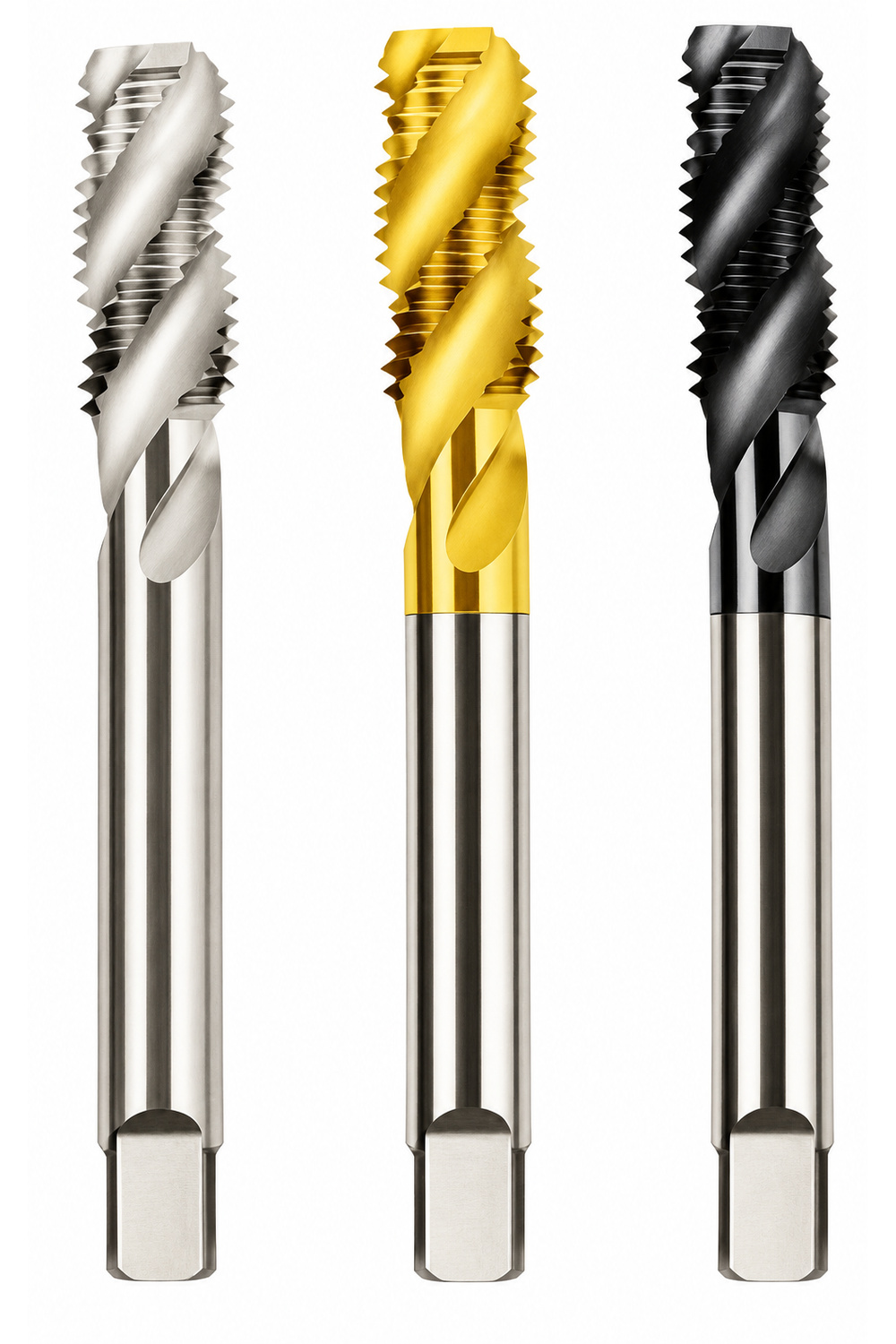
Match the pitch, blind-hole depth and holder before you build your next tap assortment.
Source metric spiral flute machine taps by the dimensions your customers actually need. This series covers 16 listed thread sizes from M2 × 0.4 to M24 × 3.0, with overall length, cutting length, shank diameter and square dimensions shown for each size.
Helical flutes carry chips back towards the hole entrance, making this tool form a common choice for blind-hole threading. Select the tool together with the workpiece material, required full-thread depth and tapping setup.
All dimensions are in millimetres. L is overall length, Lc is cutting length, d is shank diameter and k is the square width across flats.
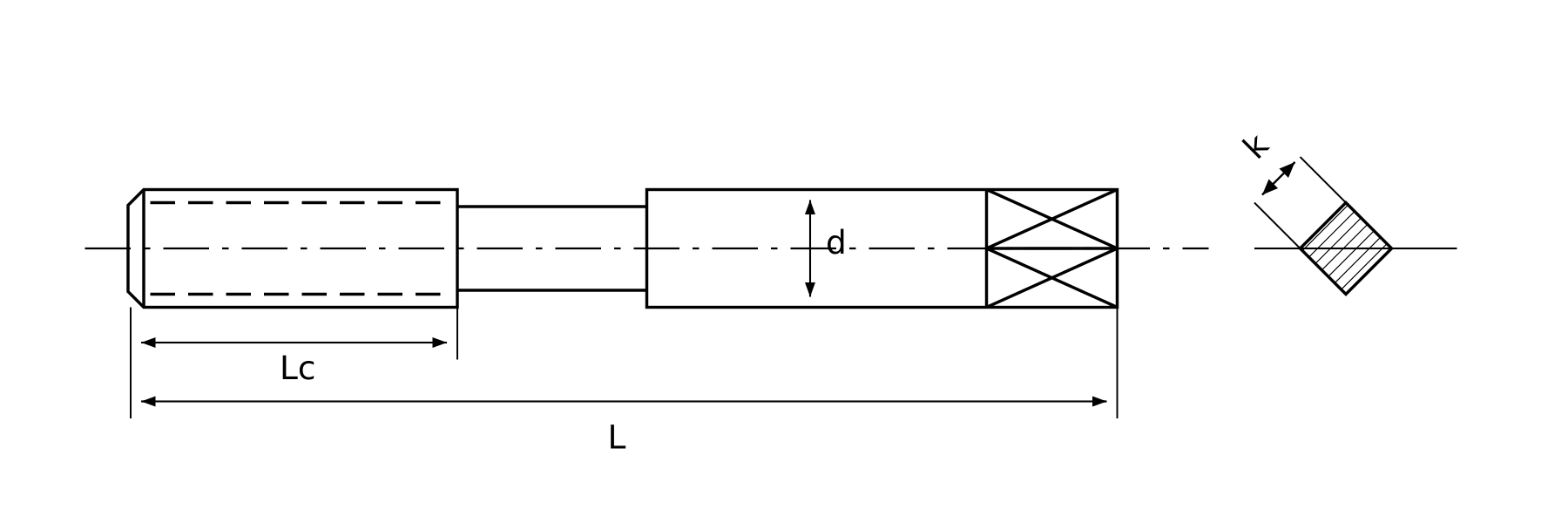
| Thread | Overall length L | Cutting length Lc | Shank Ø d | Square k | Recommended drill Ø |
|---|---|---|---|---|---|
| M2x0.4 | 45 | 7 | 3 | 2.5 | 1.6 |
| M2.5x0.45 | 49 | 8 | 3 | 2.5 | 2.1 |
| M3x0.5 | 49 | 9 | 4 | 3.2 | 2.5 |
| M3.5x0.6 | 52 | 13 | 4 | 3.2 | 2.9 |
| M4x0.7 | 56 | 11 | 5 | 4 | 3.3 |
| M5x0.8 | 64 | 13 | 5.5 | 4.5 | 4.2 |
| M6x1.0 | 66 | 15 | 6 | 4.5 | 5 |
| M8x1.25 | 70 | 16 | 6.2 | 5 | 6.8 |
| M10x1.5 | 75 | 20 | 7 | 5.5 | 8.5 |
| M12x1.75 | 82 | 22 | 8.5 | 6.5 | 10.3 |
| M14x2.0 | 88 | 25 | 10.5 | 8 | 12 |
| M16x2.0 | 95 | 32 | 12.5 | 10 | 14 |
| M18x2.5 | 100 | 37 | 14 | 11 | 15.5 |
| M20x2.5 | 100 | 37 | 15 | 12 | 17.5 |
| M22x2.5 | 115 | 38 | 17 | 13 | 19.5 |
| M24x3.0 | 120 | 45 | 19 | 15 | 21 |
Use the drill diameters as starting references for a cutting-tap setup. Select the final hole size against the workpiece material, required thread engagement and acceptance criteria. Cutting length is not the guaranteed full-thread depth: allow for the cutting lead, bottom clearance and chip space.
A blind hole has no exit for chips beneath the thread. Spiral flutes help draw chips back out through the entrance instead of pushing them towards the bottom. Provide both the required full-thread depth and the drilled-hole depth so the cutting lead and bottom clearance can be assessed.
For a through hole with a clear exit, compare a spiral point tap before specifying this series. A spiral point tap directs chips ahead of the cutting edge; it is a different tool form.
Workpiece grade matters more than a broad label such as “metal.” For steel, stainless steel or aluminium enquiries, include the exact grade and hardness where known. Tool material, helix geometry, surface treatment and lubricant must be matched to that application. For an aluminium-focused assortment, compare the dedicated M35 aluminium spiral flute series as a separate option.
Check shank diameter, square width, available clamping length and machine access. For example, the M6 × 1.0 tap has a 6 mm shank and a 4.5 mm square, with 66 mm overall length and 15 mm cutting length. The square is a driving feature; it does not identify a universal quick-change or impact-driver interface.
Send the machine and holder details with the application. Choose speed, feed, lubrication and reversal conditions for the actual tap and workpiece combination. Do not use overall length as a tapping-depth rating.
| Product choice | When to compare it | What to check before substitution |
|---|---|---|
| This metric spiral flute series | Metric blind-hole enquiries requiring the listed dimensions | Exact pitch, L/Lc/d/k, material and full-thread depth |
| DIN 371 spiral flute series | A customer specifies a DIN 371 dimensional series | Size-by-size dimensions and holder fit; the shared nominal thread size does not make the tools identical |
| DIN 376 spiral flute series | A customer specifies a DIN 376 dimensional series | Shank and square dimensions, reach and the required standard |
| Metric spiral point tap | Through holes with room for chips to exit ahead | Chip exit, clearance and tool geometry |
| Metric forming tap | Chipless internal threading is required in a suitable ductile material | Material ductility, forming-hole diameter, lubrication and torque requirements |
| M35 spiral flute tap for aluminium | Aluminium is the defined workpiece rather than a general metric assortment | Alloy, tool material, geometry and surface specification |
This page covers the listed general metric spiral flute series. Use the DIN-specific pages when the dimensional standard is part of the purchase specification, and the inch-thread spiral flute page for UNC, UNF or BSW requirements.
The spiral flute form carries chips back towards the shank, supporting blind-hole selection where chips cannot leave through the bottom.
Use the workpiece material to specify the helix within the catalogue’s described selection range. Include the required full-thread depth in the enquiry.
Keep the required tool material and workpiece grade on each order line, rather than selecting from surface appearance alone.
| Workpiece enquiry | Surface to specify for review | Information to include |
|---|---|---|
| Steel or iron | TiN for wear-resistance-oriented selection | Material grade, hardness where known, hole type and depth. |
| Stainless steel | TiCN | Exact stainless grade, tapping setup and lubrication requirements. |
| Aluminium alloys | Bright finish or DLC | Alloy, required thread depth and machining conditions. |
Specify the required finished-thread tolerance separately, together with the workpiece and sample acceptance criteria. Use the size-specific L, Lc, d and k values when comparing a replacement tap.
From component storage to enclosed workstations and operator access, these workshop views help structure a practical supplier review. Keep the material requirement, dimensional revision and quantities tied to each item when discussing sample approval and replenishment.
Workshop racks keep component handling visible. Attach the item designation and quantity to your storage and replenishment brief.
The machine enclosure and controls show the workstation setting. Use a dimensional revision to define the item under review.
The overview shows machines arranged along the workshop aisle. Connect the order specification to the relevant equipment route.
Machine stations sit beside a marked aisle. Define size and item identification for order handling.
The central aisle provides a view across the machine rows. Keep the size list and order quantities organised by item.
The view shows machine enclosures and overhead services. Include the application conditions in your production enquiry.
Operators and trays are visible beside the machines. Specify how each size should be identified during order handling.
The equipment view shows the surrounding workspace. Match a requested production review to the quoted item and drawing.
The aisle view shows a sequence of workstations. Use the same item revision for sample and repeat-order discussions.
Operators are visible at their workstations. Provide the dimensions and acceptance criteria that the sample review should address.
The photograph shows equipment arranged in a dedicated work area. Discuss the required tool geometry against the item drawing.
The wide view shows machine arrangement and access. Keep pack quantities and item references in the order brief.
Review stock preparation, workholding, wheel contact and component handling together with the finished-tool specification. For this spiral flute series, the purchasing reference remains the thread designation, cutting geometry, shank, square and agreed application.
Round stock is grouped at the machine feed. Include the tool-material requirement with the item specification.
The workpiece end is supported at the machining station. Define the blank and interface requirements in the drawing.
The photograph shows a supported tool, wheel and coolant. Holder fit still depends on the finished tap’s shank and square dimensions.
The feed arrangement shows components positioned for handling. Identify the required item and revision in the production brief.
A tool is held beside the working wheel under coolant. Include the required thread specification when requesting a process review.
Tools and machine fixtures are visible inside the enclosure. Use the approved specification to define the geometry under review.
The image shows components held in an indexed arrangement. Specify the finished square width for the intended holder.
The machine area includes a tray of elongated components. Keep the item size and order quantity attached to the handling brief.
Use the listed dimensions to set the sample acceptance criteria. Record the required method and acceptance limits with the item specification so that sample review and repeat-order review refer to the same dimensions.
In the inspection brief, identify which checks are required during production, which use an agreed sample plan, and which records are required for shipment approval.
| Inspection item | What the acceptance brief should define | Purchasing risk addressed |
|---|---|---|
| Thread designation and pitch | Match the complete metric designation to the order line; preserve M3.5 × 0.6 where specified. | Receiving a similar nominal size with the wrong pitch. |
| Overall and cutting lengths | Use the size-specific L and Lc values; assess full-thread depth separately. | A tool with insufficient reach or an unsuitable blind-hole clearance. |
| Shank diameter and square width | Compare d and k against the holder; M6 × 1.0 is d 6 mm and k 4.5 mm in this series. | A tap that does not fit the intended holder. |
| Drilled-hole reference | Review the listed drill diameter against material and required thread engagement. | Applying a hole size without considering the cutting application. |
Add the required finished-thread tolerance, inspection method and sample acceptance limits to the drawing or specification sent with your enquiry.
Bring the dimensions, application and packaging requirements together in one RFQ.
Start with the 16 listed metric sizes and the HSS / HSS-Co material description. Identify each item by thread size, pitch and dimensions, then add its order quantity and packaging requirement.
Use the item designation and pack quantity in your packaging brief so each size can be identified during stock handling.
Send the required size list and quantity per position when requesting an assortment layout.
State the required tool material and workpiece grade. Add a named surface treatment only where it is part of your purchase specification; colour alone does not identify a coating.
Attach your item codes, label wording, quantities by size and proposed pack layout for quotation review. For replenishment, include the approved item and packaging revision.
It cuts internal threads and carries chips towards the hole entrance. This chip path makes spiral flute taps a common choice for blind holes. The required full-thread depth, workpiece and actual tool geometry still determine the selection.
A spiral flute tap draws chips back towards the shank. A gun tap, also called a spiral point tap, directs chips forward and is commonly selected for through holes with a clear chip exit. They should not be substituted solely because the thread size matches.
For this series, check 66 mm overall length, 15 mm cutting length, 6 mm shank diameter and 4.5 mm square width. Also compare the existing holder, usable clamping length and required full-thread depth. A DIN-labelled M6 tap may have different dimensions.
No. Cutting length includes the cutting lead and is not a full-thread-depth guarantee. Provide the required full-thread depth and drilled-hole depth, then allow for the lead, bottom clearance and chip space.
Send the exact workpiece grade, hardness where known, hole type and depth. Select tool material, geometry, surface treatment and lubrication together. A silver, gold or black appearance alone is not a coating specification. Compare the dedicated aluminium series when aluminium is the main application.
Provide thread size and pitch, quantity by size, workpiece grade, blind or through hole, full-thread and drilled-hole depths, and holder details. Add material, surface, marking and packaging requirements where applicable. For repeat orders, include the agreed item code and specification revision.
Send your size-and-pitch list, quantities and application details. Include the holder dimensions and blind-hole depth to help match the enquiry to the right series.