Some diamond blades cut metal, but only products designed and rated for the particular metal and machine. A tile, porcelain or stone blade is not automatically suitable. Check the exact product's material list, mounting and operating instructions; permission to cut reinforcement inside concrete does not necessarily cover bare steel.
Can a Diamond Blade Cut Metal?
Yes, purpose-designed diamond metal-cutting wheels exist. The useful distinction is between a blade specifically rated for metal and a tile or stone blade that merely contains diamond. “Diamond blade” names a broad family, not a complete application specification.
LENOX MetalMax, for example, is a manufacturer-described diamond metal-cutting wheel family with a stated metal application list. That example answers the general question without extending its permission to a different manufacturer's tile blade or to every product with a similar appearance.
For a buyer, the next question is therefore which metal, which section and which machine. Cutting a steel tube is a different requirement from trimming porcelain, cutting reinforced concrete or making a finish cut through stone. Start with the workpiece and operation, then identify the rated tool.
Do not use a successful demonstration with an unidentified blade as the purchasing specification. Ask for the actual product code and instructions. A replacement needs the same approved application and mounting relationship, not simply the same diameter or a silver-coloured cutting edge.
Identify the Tool Before Comparing Blades
Several products are casually described as a diamond disc. Their cutting edges, mounting and intended operations differ. Establishing the product category first prevents a quotation for the wrong tool and a photograph being used as evidence for an unrelated application.
| Product Category | Intended Selection Question | What Must Be Verified |
|---|---|---|
| Tile, porcelain or stone diamond saw blade | Which listed material and edge finish are required? | Exact material range, machine, mounting and wet/dry permission |
| Diamond wheel rated for metal | Which metal and section will be cut? | Product-specific metal list and machine instructions |
| Reinforced-concrete diamond blade | What concrete and embedded reinforcement are involved? | Permission for the complete reinforced-concrete application |
| Bonded abrasive metal cut-off wheel | Does the wheel suit the metal and cutting machine? | Material rating, wheel dimensions, mounting and operating limits |
| TCT metal-cutting saw blade | Which toothed blade suits the metal and saw? | Tooth design, workpiece range and saw compatibility |
| Diamond cup grinding wheel | Which surface-grinding task is required? | Grinding application and compatible machine; it is a different tool from a saw blade |
Keep cutting and surface grinding separate. A saw blade's rim is intended for its stated cutting operation. It should not be selected as a face-grinding tool merely because another diamond product is used to grind concrete.
Why Tile and Stone Blades Do Not Establish a Metal Rating
A blade's performance depends on its complete construction, including the cutting edge and the system holding the abrasive. The presence of diamond alone does not establish which workpiece, contact conditions or machine the product is intended to handle.
For tile work, the purchasing requirement often includes edge quality and resistance to visible chipping. For metal cutting, the workpiece grade, section, cut completion and permitted machine combination become a different application. A single abrasive name does not resolve those differences.
The practical evidence is the product's stated application. Look for the exact material list and any restrictions attached to the model or size being quoted. A broad category description can be less specific than the instructions for the individual blade.
For an existing tile or stone enquiry, begin with the diamond saw blade range and describe the actual material and machine. If the job changes to metal, treat that as a fresh application review. Do not carry a recommendation across merely because a blade is already on hand.
Reinforced Concrete and Bare Metal Are Different Jobs
A reinforced-concrete cut involves a mineral workpiece containing steel reinforcement. A blade may be intended for that combination without being intended for continuous or standalone cutting of bare metal. Encountering reinforcement within the approved application is not a general steel-cutting rating.
Bosch Professional's diamond-blade guidance makes this distinction when discussing embedded rebar and pure-metal applications. The permission belongs to the blade and task described by the manufacturer; it should not be inferred from the word “concrete” alone.
For a site order, separate “cut reinforced concrete” from “cut loose rebar.” Those are two purchase requirements even when they occur on the same project. If a supplier proposes one model for both, request the product information that explicitly covers each operation.
Also describe mixed materials accurately. A masonry opening with an unknown metal insert, steel plate attached to concrete and reinforced concrete are not necessarily equivalent. When the workpiece composition is uncertain, identify it before selecting a blade rather than using “multi-material” as a substitute for the missing detail.
Rim Appearance Is Not a Material Approval
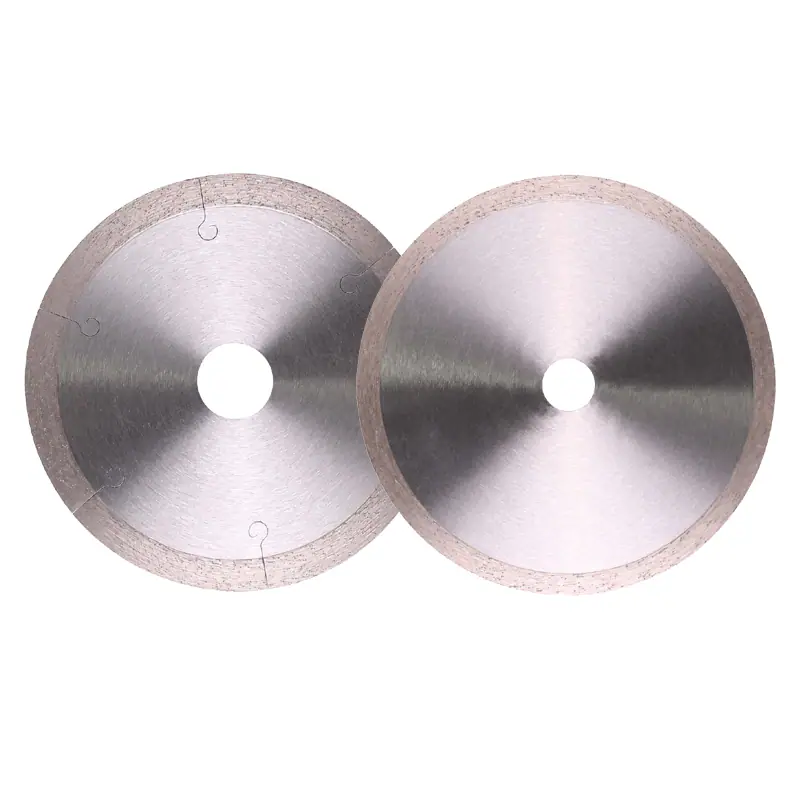
Continuous, segmented and other rim forms help describe a blade, but appearance alone cannot confirm its material range. Different products can share a general outline while having different constructions and operating permissions. Likewise, a visible segment gap does not mean a blade is intended for metal.
Product photographs are useful for identifying the offered model, mounting and visible marking. They are weaker evidence for hidden construction, bond characteristics or an application that the marking does not name. Use photographs alongside the product information, not in place of it.
When comparing offers, avoid making colour or rim shape the deciding field. Record the product code, dimensions, material rating and machine type. This keeps an apparently similar lower-priced item from silently becoming an unapproved substitute.
If a quotation for a metal-cutting wheel uses a tile or stone product photograph, ask the supplier to identify the exact offered model and provide its corresponding technical record. Match the photograph, markings and product code before approving the sample; a generic image leaves the quoted construction and application uncertain.
Match the Blade to the Complete Machine Setup
Physical fit is one part of compatibility. The blade also has to suit the machine type, permitted diameter, mounting arrangement, guarding and operating speed. A bore that fits the spindle does not answer those other questions.
Identify the machine model before selecting the blade. An angle grinder, tile saw, circular saw and stationary cut-off machine are not interchangeable blade platforms. A recommendation for one machine type should not be transferred to another just because an adapter could make the hole fit.
The blade's marked maximum RPM must be at least as high as the machine's maximum no-load spindle speed for the approved configuration. If variable-speed operation is proposed, verify that arrangement in both manufacturers' instructions rather than assuming a lower dial setting establishes compatibility. A maximum blade rating is a limit, not a universal recommended cutting speed. Use the selected blade and machine instructions for operating conditions rather than borrowing an RPM from a different blade family.
Mounting details also need precise language. A plain bore, a threaded interface and a purpose-designed flange arrangement are different connections. Do not enlarge a bore, improvise a mounting or remove required guarding to accommodate a purchase error. Resolve the mismatch with the correct blade or machine combination.
Match Wet or Dry Use to the Blade and Machine
Wet and dry cutting depend on the blade’s rated use and the machine’s design, rather than the workpiece material alone. A blade intended for wet operation does not become a dry blade because the cut is short. A dry-capable blade does not make every machine suitable for adding water.
Read the blade and machine instructions together. The combination must permit the intended method, including its required accessories and controls. Water should never be introduced to equipment or a setup that is not intended for wet operation.
Cooling is also not a way to extend an unsuitable blade's material range. Adding water to a tile blade does not create a metal rating. Likewise, the absence of visible overheating during a brief demonstration does not establish that a blade is approved for the job.
For purchasing, put the required method in the enquiry beside the machine model. A contractor who needs dry cutting at a particular location and a workshop using a suitable wet saw are asking for different combinations. Stating that difference early prevents an otherwise correctly sized blade arriving for the wrong setup.
Describe the Metal and Section Precisely
“Metal cutting” is too broad for a useful comparison. State whether the workpiece is carbon steel, stainless steel, cast iron, aluminium or another identified metal. Include the grade where it is known, especially when replacing a blade for a repeat production operation.
The section matters as well. Sheet, solid bar, tube and profile present different contact conditions. Give the wall thickness or solid-section dimensions and describe whether the cut is straight, repeated, interrupted or made in an installed assembly.
State the finish requirement separately. A rough separation cut and a cut that needs an acceptable visible edge may have different purchasing priorities. A blade that finishes the cut is not automatically the lowest-cost choice if it leaves additional work or rejects.
For a buyer comparing trial samples, retain these details in the record. Otherwise, a blade demonstrated on thin mild-steel tube may be ordered for a substantially different section, with the original demonstration mistakenly treated as proof of suitability.
Compare Alternatives Within Their Approved Applications
A specifically metal-rated diamond wheel is one possible category. Depending on the workpiece and machine, a bonded abrasive cut-off wheel or a suitable TCT metal-cutting blade may also be considered. Each needs its own compatibility and application check.
For AXIMET enquiries involving toothed blades, review the metal-cutting saw blade collection or TCT circular saw blade collection with the actual saw and material details. These links identify related product categories; they do not make a circular saw blade suitable for an angle grinder.
Compare the accepted cut, not only blade purchase price. Relevant costs can include changeovers, finishing work and rejected pieces as well as the consumable itself. Define the required cut quality before a trial so an apparently cheaper result is not accepted on a different standard.
Keep manufacturer performance claims tied to their stated test conditions. A cut-count claim for one size and workpiece cannot establish a general life multiplier, and a competitor's claim is not an AXIMET product result. Ask for results relevant to the offered item and your operation.
Problems That Should Trigger an Application Review
Poor cutting does not prove that more pressure, a different speed or added water is the answer. An unsuitable blade, mounting mismatch, workpiece movement or an operation outside the stated application can produce problems that cannot be corrected by improvising settings.
| Observed Issue | Information to Gather Before Choosing a Replacement |
|---|---|
| Blade does not complete the cut acceptably | Actual material, section, product code and approved application |
| Unexpected damage or unusual vibration | Blade condition, mounting, machine model and workholding details |
| Edge quality fails the requirement | Workpiece, required finish and the intended cutting method |
| Replacement fits but behaves differently | Both product codes, dimensions, machine ratings and instructions |
| Wear result differs from a demonstration | Actual workpiece and trial conditions compared with the demonstration |
These observations support a review; they are not permission to continue with a damaged or unstable tool. Stop the operation and follow the manufacturer's inspection and replacement instructions where damage or abnormal behaviour occurs.
For a supplier discussion, clear photographs of the marking, mounting and workpiece can be more useful than a general message saying the blade is “not strong enough.” Preserve the product identity so the recommendation can address the actual combination.
Make Sample Approval Useful for a Bulk Order
Agree the intended material, machine and cut before samples are evaluated. A useful acceptance record identifies the blade model and dimensions, the approved application and the outcome that counts as a satisfactory cut. It also states the required edge condition.
Evaluate on representative workpieces using the product and machine instructions. Record accepted cuts, finishing requirements, changeovers and the reason for ending the trial. Do not turn a different material or an unidentified machine into an apparently comparable test just to obtain a cut-count figure.
For repeat orders, link the approved sample to the offered product code and specification. If the supplier proposes a different construction, material range or mounting, review the change before accepting it as equivalent. Matching packaging dimensions is not enough.
Distributors also need accurate downstream descriptions. Keep tile/stone, reinforced-concrete and standalone-metal permissions distinct in item records and sales copy. This reduces avoidable returns and prevents a broad “diamond disc” label being interpreted as permission for every cutting task.
What to Send with an Enquiry
Provide the workpiece material and section, machine make and model, required diameter, mounting dimensions, cut depth and wet/dry requirement. Include the current blade code or a clear marking photograph when replacing an existing product.
Add quantity, intended order mix and the result the customer needs: clean tile edges, a specified metal section or a reinforced-concrete application. Keep packaging requests separate from the technical specification so a retail format does not obscure the blade being approved.
If no suitable product has yet been identified, ask which rated category fits the application. Do not request a tile blade for metal merely because the existing machine already carries one. A precise enquiry gives AXIMET a clear starting point for discussing relevant product options without implying that every diamond-blade application is interchangeable.
Frequently Asked Questions
Can a Porcelain Diamond Blade Cut Steel?
Do not use it on that assumption. The particular blade must explicitly permit the steel application and match the machine, mounting and operating conditions. A porcelain rating establishes a different workpiece requirement; the diamond edge alone does not extend it to metal. Identify the product code and read its material list. If steel is not included, select a product intended for that metal-cutting task instead of trying to compensate with pressure or water.
Can I Cut Bare Rebar with a Concrete Diamond Blade?
Permission to cut reinforcement inside concrete does not automatically cover cutting loose rebar as a standalone metal job. Some manufacturers expressly distinguish those applications. Check the exact blade's instructions and material list rather than relying on a reinforced-concrete label. If the operation is bare-metal cutting, select a product explicitly rated for that operation and metal, with the correct machine relationship. Treat the two jobs separately when ordering for a site.
Does a Segmented Rim Mean the Blade Is Suitable for Metal?
No. Segment gaps and rim appearance describe visible construction, not a complete material rating. Blades with similar outlines can have different intended workpieces and operating permissions. Use the exact product code, material list, dimensions and machine instructions to identify suitability. A photograph can help confirm which product was offered, but it cannot establish an unlisted application or show every relevant aspect of the blade's construction.
Is a Matching Bore Enough to Make a Blade Compatible?
No. Also verify the machine type, permitted blade diameter, mounting arrangement, guarding, rotation and operating-speed limits. The intended workpiece and wet/dry method must be covered by the blade and machine combination. Do not use an adapter as proof of application suitability or modify the blade to fit. If any of those relationships differ from the instructions, resolve the mismatch before accepting the blade for use.
Does Water Make a Tile Blade Suitable for Metal?
No. Cooling does not change the product's material rating. A blade intended for tile or stone still needs explicit metal-cutting permission, and the machine itself must permit wet operation before water is considered. Similarly, dry-cutting permission belongs to the specified blade and setup. Choose the rated tool first, then follow its permitted operating method; do not use water or a short demonstration to justify an otherwise unsupported application.
How Should an Importer Compare Diamond Metal-Cutting Wheels?
First confirm that each offered model covers the same metal, section and machine requirement. Then compare representative samples against an agreed cut-quality standard, recording accepted cuts, changeovers and finishing work. Retain product codes and trial conditions with the approval. Avoid applying one manufacturer's advertised life figure to another product or a different workpiece. A repeatable specification and comparable result are more useful than an isolated lowest price or demonstration cut count.
Conclusion
Choose a diamond blade by its stated application and the complete machine setup. Keep tile/stone, reinforced-concrete and bare-metal cutting requirements distinct; rim appearance and spindle fit cannot substitute for a material rating. Send AXIMET the workpiece, section and machine details with the required dimensions so the discussion begins with the appropriate blade category and a clear acceptance requirement.