Cobalt drill bits use a cobalt-alloyed high-speed steel body. Titanium drill bits usually have a titanium-based surface coating. Compare the alloy, coating, geometry and intended material together: those details determine whether a drill suits your work and remains economical after wear or resharpening.
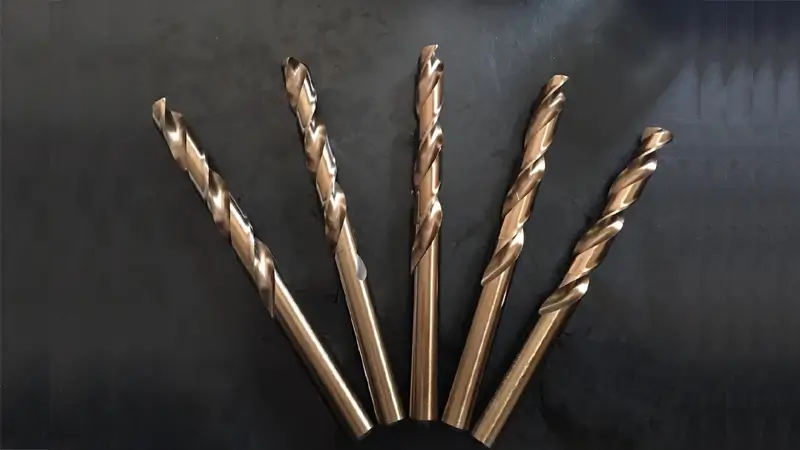
Cobalt vs Titanium Drill Bits: the Main Difference
Cobalt describes an ingredient in the drill material. Titanium normally describes a coating applied to that material. They are separate specifications, so a cobalt drill and a titanium-coated drill are not necessarily opposite choices. A cobalt-alloy drill can also receive a titanium-based coating.
For buyers, the useful question is which complete drill produces acceptable holes in the intended operation. A material label alone cannot answer that. Two drills with the same cobalt designation can have different points, lengths and application ranges; two gold-coloured drills can have different substrates and coatings.
| What You Are Comparing | Cobalt-Alloy HSS Drill | Titanium-Coated HSS Drill |
|---|---|---|
| Distinguishing feature | Cobalt forms part of the high-speed steel alloy | A titanium-based compound forms a surface coating |
| Information still needed | Grade, point, flute, length, finish and application | Underlying grade, exact coating, geometry and application |
| Resharpening | Proper regrinding exposes the same base alloy | Regrinding removes coating from the surfaces being ground |
| Possible overlap | A cobalt-alloy body may also be coated | The coated substrate may itself contain cobalt |
| Useful purchasing test | Performance of the complete drill in your operation | Performance of the complete drill in your operation |
Keep alloy and coating in separate fields when comparing quotations. Otherwise, a supplier may quote a different underlying material while appearing to offer the same product description.
What Cobalt Adds to a High-Speed Steel Drill
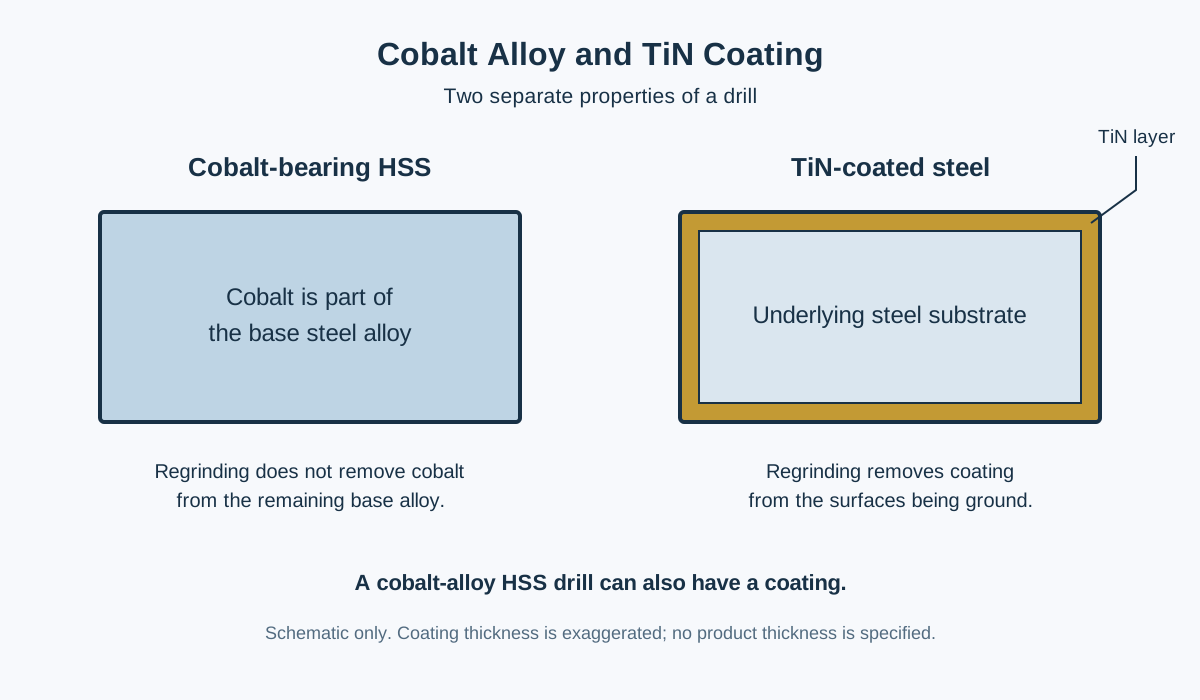
Cobalt-alloy HSS is used where retention of cutting-edge hardness at elevated temperature matters. M35 and M42 are familiar grades, commonly associated with nominal cobalt contents of 5% and 8% respectively. These are alloy designations, not coatings that disappear when the outside of the drill is ground.
That distinction helps explain why cobalt drills are often considered for demanding metalworking. It does not establish a universal drilling capacity. The finished tool still depends on its geometry and manufacturing condition, and its application range must suit the workpiece. More cobalt is not a complete explanation of why one drill succeeds while another fails.
Compare the M35 cobalt drill bit range and M42 cobalt drill bit range against the required hole, rather than treating the grade names as a simple ranking. For a repeat purchase, retain the agreed grade alongside the diameter, length and point preparation. Changing several of these together makes a later performance difference difficult to explain.
What a Titanium Coating Changes
“Titanium drill bit” normally means a drill with a titanium-based coating, often titanium nitride, or TiN. It does not mean a twist drill made from solid titanium. Other titanium-based coatings have their own compositions and application guidance; they should not all be purchased under one unspecified coating name.
The coating works at the surface, while the underlying drill material supports the cutting edge. A suitable coating can improve wear behaviour in an appropriate application. It cannot make an unsuitable substrate, excessive tool length or poor workholding disappear.
The two descriptions can genuinely overlap. For example, Guhring lists a drill with an HSCo substrate and a TiN coating. That example demonstrates why a technical comparison should separate the alloy from its surface treatment. It does not mean every coated cobalt drill has the same properties.
Colour is also an unreliable specification. A gold appearance may help identify a particular supplier's range, but appearance alone does not establish coating chemistry, cobalt content or drilling suitability. Use the stated material and treatment when selecting and ordering.
Drilling titanium metal is a separate application question. A titanium-based coating does not, by itself, identify a drill intended for a titanium workpiece. If that is the material you need to machine, specify the actual alloy and hole requirement, then select from the finished tool's material guidance. Keeping workpiece material separate from coating terminology prevents a superficially matching product description from becoming the wrong order.
Choose for the Material You Actually Drill
Begin with the workpiece, then shortlist complete tools. Mild steel, stainless steel, aluminium and heat-treated steel do not present the same cutting conditions. The word “metal” is too broad to make a useful purchasing specification.
| Workpiece or Buying Situation | Useful Starting Point | What to Compare Before Ordering |
|---|---|---|
| Repeated drilling in a known stainless grade | Application-rated cobalt HSS or a suitable coated drill | Finished-tool geometry, length, coolant method and acceptable hole consistency |
| General fabrication in a known steel grade | A drill intended for that steel and the available machine | Unit price together with wear, changeovers and hole quality |
| Aluminium and other non-ferrous work | A material-specific drill and coating recommendation | Chip flow, adhesion problems and explicit material suitability |
| Hardened or heat-treated components | A drill with a documented application range covering the condition | Actual hardness, hole requirement, machine and coolant |
| Mixed-material distributor range | Separate application groups where necessary | Clear product descriptions, replacements and sizes customers repeatedly use |
Stainless Steel
For stainless work, select against the actual grade and condition. “Stainless” describes a family of alloys; it does not identify one uniform machinability or hardness. A recommendation for one stainless grade should not automatically be extended to every other grade.
Cobalt-alloy HSS is a relevant option, but compare the whole tool with any coated alternative. A short drill intended for stainless work and a longer general-purpose drill may behave differently even if their cobalt percentage matches. Record which operation causes trouble: starting the hole, maintaining chip removal, reaching depth or breaking through. That is more useful than asking only for a harder drill.
Mild Steel and General Fabrication
In a straightforward fabrication job, the premium material is not automatically the economical choice. The necessary drill must first meet the hole requirement on the machine being used. Beyond that, the purchase decision depends on how long the tool remains useful, how often it is changed and whether holes need additional work.
Occasional workshop drilling and a production batch can therefore justify different choices. A low purchase price may suit an infrequent task, while repeated production can make consistent results and fewer interruptions more valuable. Establish the operation before deciding how much to spend on an alloy or coating upgrade.
Aluminium
Check aluminium suitability separately from a general “for metal” description. RUKO’s TiN coating guidance treats aluminium use as restricted, while suitability still needs to be checked against the exact drill’s application instructions. Do not transfer permission from one TiN-coated product to another. The coating name alone does not establish which aluminium grades, machines or operating conditions are covered.
For a mixed-material order, specify the aluminium work explicitly. Do not assume that a drill selected for steel should also become the default aluminium option simply because its coating looks similar to an existing product.
Hardened Steel
Hardened steel needs a more specific selection than either cobalt or titanium as a headline. The measured hardness, steel condition and machine determine which tooling approach is realistic. A higher cobalt percentage does not supply an unlimited hardness rating, and adding a coating does not make every HSS drill suitable for a heat-treated component.
Use the guide to drill bits for hardened steel when the material has been hardened or its condition is uncertain. It explains which workpiece and setup information should come before a production order.
Compare Geometry and Length Before Blaming the Alloy
A drill's point and flute form affect how it enters the work and removes the resulting chips. Overall length, usable flute length and the amount projecting from the holder also matter. An alloy comparison becomes misleading when these features change at the same time.
Choose the shortest suitable reach for the operation, while leaving the necessary clearance and chip space. Extra length may be essential for access, but it should serve a real requirement. Buying a longer drill “just in case” can introduce a difference that has nothing to do with cobalt or coating.
Point angle and split-point preparation are separate features. One describes the included angle; the other describes how the point is formed. When replacing an established tool, retain both details where they affect the process. See the drill point angle guide for the distinction.
For a fair trial, match diameter, usable length and hole requirement first. If one candidate needs a different holder or operating method, include that difference in the evaluation rather than presenting the result as a pure material comparison.
What Happens After Sharpening?
A cobalt-alloy HSS drill remains cobalt-alloy HSS after correct regrinding. The material does not become ordinary HSS because the outer appearance changes. The reground point still needs the intended cutting geometry and suitable edge condition.
A coated drill loses coating from the surfaces being reground, although coating may remain on other parts of the tool. IRWIN's technical explanation makes this distinction between the reground tip and the remaining coated surfaces. A serviced drill should therefore be evaluated as a serviced tool rather than assumed to perform exactly like a new one.
Regrinding quality matters for both categories. Unequal lips, an unsuitable point or excessive damage cannot be corrected by the material name. When assessing a sharpening service, check whether it can restore the required geometry, not simply produce an edge that looks sharp.
Include handling and inspection in the economics. For some smaller or infrequently used drills, managing regrinds may not be worthwhile. For an established production tool, a repeatable servicing route can be relevant. The answer comes from actual usable service, not an assumed number of sharpenings.
Measure Cost per Acceptable Hole
The useful comparison includes more than drill price. A hole that is out of tolerance, poorly located or damaged at breakthrough may create rework or scrap even if it was drilled quickly. Agree what counts as acceptable before measuring tool life.
A practical comparison includes tool purchase, any worthwhile regrinding, changeover time and rejected or reworked holes. Divide the relevant total by the number of acceptable holes produced under the agreed conditions. This is a purchasing method, not a predicted performance figure for either material.
Keep the calculation proportionate. A maintenance workshop may mainly care about finishing the required repair without repeated tool changes. A production buyer may need cycle time, consistency and predictable replacement intervals. An importer may need a product that customers can select correctly and reorder without substitution complaints.
Record why a tool was removed from service. Gradual wear, edge chipping, breakage and an unacceptable hole are different outcomes. Combining them under “did not last” hides the information needed to choose the next tool.
Run a Useful Sample Comparison
Use representative material and the actual hole requirement. A successful demonstration in a softer plate does not establish performance in a harder production component, even when both are casually described as steel.
1. Identify each candidate by its complete product description, including material and coating. 2. Use comparable diameter, length and point geometry, or record the necessary differences. 3. Establish the permitted operating method for each tool and keep it repeatable. 4. Inspect hole quality and cutting-edge condition at agreed intervals. 5. Record the reason for stopping and the number of acceptable holes produced.
Where a candidate requires different cutting data, evaluate it under its recommended method. Forcing every drill to run at the same arbitrary speed can disadvantage a suitable tool and does not necessarily represent how it would be used in production.
Keep a fresh-tool result separate from a reconditioned-tool result. This makes the decision easier to defend later: the order can specify the successful tool and service condition instead of relying on a general impression of which colour or alloy “felt better.”
What to Put in a Bulk Enquiry
Send the workpiece grade, material condition, hole diameter and depth, machine and coolant arrangement. Add the required size list, quantities and any existing tool reference. These are the details that allow a supplier to compare a replacement with what you already use.
State alloy and coating separately. If the requirement is M35, say M35; if it also requires TiN, record TiN as its own field. Include point preparation and length where they affect the application. A request for “premium gold cobalt bits” leaves too much room for different interpretations.
For a distributor assortment, identify which diameters need routine replenishment and whether the products will be sold singly or in sets. Evaluate the actual product selection before requesting a broader assortment. A large set is not automatically better stock if most customers repeatedly consume only a few sizes.
Where you are replacing an established drill, include a clear photograph of its marking and a description of the problem being solved. That gives a more useful starting point than asking for a universally better grade.
Frequently Asked Questions
Are Titanium Drill Bits Made from Titanium?
In this comparison, the name usually refers to a titanium-based coating on another drill material, commonly HSS. The drill body and the coating perform different jobs, so both belong in the specification. Ask which alloy supports the cutting edge and which coating is applied to it. A gold appearance does not answer either question reliably. For repeat orders, retain the complete description rather than substituting a colour-based product name.
Can a Cobalt Drill Also Have a Titanium Coating?
Yes. Cobalt content describes the underlying high-speed steel, while a titanium-based coating describes the surface. Some commercial tools combine those features. Comparing “cobalt versus titanium” without separating them can therefore mix unlike categories. Evaluate the complete drill against the workpiece and machine, then record alloy, coating, geometry and length independently. The existence of a coated cobalt tool does not establish that every supplier offers the same combination or application range.
Is M42 Always Better Than M35?
No. M42 and M35 identify different cobalt-alloy HSS grades, but finished-tool suitability depends on more than cobalt content. Compare geometry, reach, material application and operating conditions alongside the grade. If the current problem is poor workholding, an unsuitable point or obstructed chip removal, changing the alloy alone may leave that problem unresolved. Use representative drilling results to judge the required improvement rather than assuming the larger cobalt number guarantees it.
Can Cobalt and Titanium-Coated Drill Bits Both Be Sharpened?
Both may be reground where the tool design and remaining condition permit it. A cobalt-alloy body retains its alloy composition. A coated drill loses coating on the surfaces that are reground, while coating can remain elsewhere. In either case, correct point restoration matters. Include the quality and cost of servicing in the comparison, and check the reground tool against the hole requirement before assuming it will duplicate the performance of a new drill.
Which Type Should I Buy for Stainless Steel?
Start with a finished drill intended for the actual stainless grade and operation. Cobalt-alloy HSS is a relevant option, but the point, flute, length and operating method remain important. A suitable coated drill is another possible route; the coating name alone cannot establish suitability. Identify whether the task is occasional maintenance, repeated fabrication or a controlled production batch. Then compare acceptable holes, wear and interruptions under conditions representative of that task.
Are Titanium-Coated Drills Suitable for Aluminium?
Check the exact tool's material list and operating guidance. Titanium-based coatings are not one uniform specification, and a coating described as TiN does not give every drill the same aluminium application range. RUKO, for example, describes aluminium use with TiN as restricted. Do not extend a steel-drilling recommendation to aluminium based on colour or a broad “for metal” description. For an assortment covering both materials, select each drill by its own geometry, surface treatment and stated application range.
Conclusion
Cobalt versus titanium is an alloy-versus-coating comparison, not a universal ranking. Separate those specifications, choose for the actual material and machine, and measure the result through acceptable holes and useful service. For an AXIMET enquiry, send your material, hole requirement and size list, or begin with the HSS and cobalt drill bit collection.