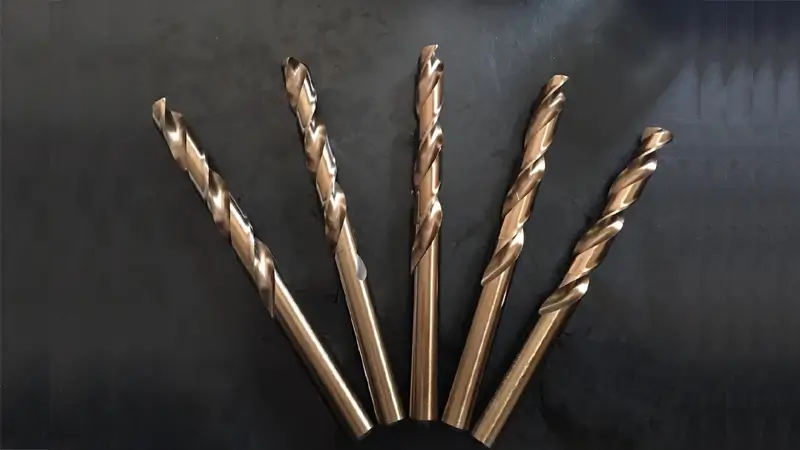
M42 Cobalt Twist Drill Bits
M42 cobalt twist drill bits use high-speed steel alloyed with 8% cobalt. For a replacement drill, match the complete tool specification before changing grade or geometry. For a new application, assess the workpiece and machine conditions alongside the hole diameter, depth and holder fit.
What the M42 Designation Tells You
| Specification | Description |
|---|---|
| Material designation | M42 Co8% |
| Tool form | Cobalt-bearing HSS twist drill |
| Dimensions needed for selection | Diameter, flute length and overall length |
| Additional selection details | Length series, point geometry, shank and finish |
The grade describes the base steel rather than a surface treatment. An M42 drill can still differ in point geometry, flute design, length, shank and finish. Those features affect how the complete tool fits and works in the drilling setup.
Comparing M42 with a 5% Cobalt Drill
M42 and M35 cobalt drills are different grades, identified here as Co8% and Co5% respectively. A change of grade also needs a review of the finished tool and its operating conditions. It is not a direct measure of how many holes the drill will produce.
When comparing an M42 option with an existing drill, use the same workpiece, hole size, depth and machine conditions. Note the point geometry and surface treatment as well as the material grade. That gives you a meaningful basis for evaluating the tool rather than comparing the cobalt labels alone.
Replacing an Existing M42 Drill
Compare the replacement against the complete tool already used for the job: grade, diameter, point geometry, flute length, overall length, shank and finish. A matching diameter does not ensure the same reach or holder fit. Keep the workpiece and drilling conditions the same when evaluating a change, so a geometry change is not mistaken for a material-grade difference.
Point angle and split-point form describe different aspects of the tip. If either is part of the approved tool specification, retain it in the replacement requirement. A drawing or existing tool code can help identify the configuration without relying on surface colour.
Selecting M42 for a New Drilling Job
Start with the workpiece grade and condition, required hole diameter and depth, then assess the machine and workholding. The drill needs enough working reach and chip clearance, while its shank must fit the holder's gripping dimensions. A longer tool and a different point can change the setup even when the alloy remains M42.
Steel or stainless-steel grade, heat treatment, hole depth and coolant arrangements all influence selection. These details distinguish a straightforward replacement from an operation that needs a different tool configuration.
For hardened material, include its stated hardness and heat-treatment condition. The word “M42” alone does not establish that a drill is suitable for every hardened-steel job. The drill bits for hardened steel guide explains the selection factors.
M42 Cobalt Drill Bit FAQs
Does M42 Mean 8% Cobalt?
M42 is commonly identified as an 8% cobalt high-speed steel, also described as Co8%. It is a base-material designation rather than a coating description. The finished drill still needs its geometry, dimensions and finish specified separately.
Is M42 Always the Best Choice Over M35?
There is no universal choice based on cobalt content alone. The workpiece, finished tool geometry, heat treatment and operating conditions all matter. Compare complete tools for the actual operation rather than using the grade label as a tool-life promise.
Is Titanium-Coated HSS Equivalent to M42?
No. A titanium-based coating describes a surface layer; M42 identifies the base steel. A coated tool still needs its substrate grade specified. See Cobalt vs Titanium Drill Bits for the comparison.
Does the Same Diameter Guarantee a Replacement Will Fit?
No. Match flute length, overall length and shank dimensions as well as diameter. The point geometry and required drilling depth also need to suit the operation.
Is M42 the Same as a Solid Carbide Drill?
No. M42 is a cobalt-bearing high-speed steel; solid carbide is a different tool material. They are not substitutes based on diameter alone. The workpiece, drill design, holder, machine rigidity and coolant arrangement determine which finished tool suits the operation. Use the exact tool's application guidance when comparing the alternatives.
How Should I List Several M42 Drill Sizes?
Use one line per size and configuration, with its own quantity. Include diameter, flute length, overall length or length series, point, shank and finish. Keep M35 and M42 requirements on separate lines when requesting both grades.
Request an M42 Drill Quotation
Send the M42 sizes and quantities you need, together with the workpiece material and hole depth. For a replacement, include the existing tool code, dimensions or drawing. For a new job, add the machine and holder details.