
M35 Cobalt Twist Drill Bits
M35 cobalt twist drill bits use high-speed steel alloyed with 5% cobalt. Choose the diameter, drilling reach and point geometry for your metalworking operation, then match the shank to the holder. Material grade, geometry and fit all matter when selecting a drill or replacing an existing tool.
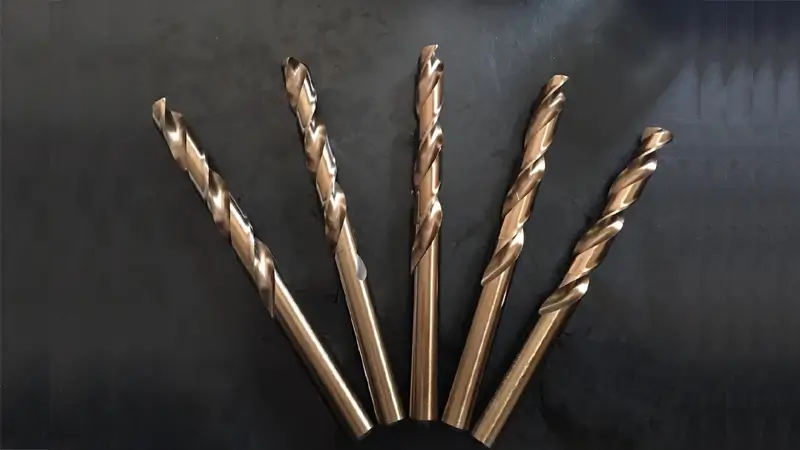
M35 Material at a Glance
| Specification | Description |
|---|---|
| Material designation | M35 Co5% |
| Tool form | Cobalt-bearing HSS twist drill |
| Dimensions needed for selection | Diameter, flute length and overall length |
| Additional selection details | Length series, point geometry, shank and finish |
M35 identifies the drill's base material. It is different from a coating applied to the surface. Keep the material grade and any coating requirement separate in your specification, particularly when replacing an existing tool or comparing quotations.
Choose the Diameter and Reach Together
Start with the required hole diameter and the workpiece thickness. Then allow for the drilling depth, chip clearance and space between the workpiece and holder. Flute length and overall length serve different purposes: the flutes provide chip clearance, while overall length also includes the gripping shank.
Include the length series or a reference drawing with your size list. A diameter alone does not identify the complete tool, and a general DIN dimension chart does not identify which dimensions are offered in M35.
Match the Point and Shank to the Operation
Point angle and split-point geometry describe different features. Specify both when either is part of your approved tooling requirement. The shank must also match the chuck or holder's gripping dimensions.
For a replacement drill, a drawing or the existing tool's full specification is more useful than its colour. Bright, dark or gold-coloured surfaces do not identify the steel grade or point geometry.
Selecting M35 for a Metalworking Job
M35 cobalt HSS is used for metal-drilling applications that include stainless steel. Start with the actual metal grade and its condition: “steel” or “stainless steel” alone can describe substantially different drilling jobs. Match the drill geometry and dimensions to the hole, workholding and machine. The material designation alone does not set the operating speed or establish suitability for every stainless-steel application.
For a through-hole in plate, the drill needs enough reach and chip clearance to complete the hole. A deeper hole or restricted access changes that requirement even when the diameter stays the same. Machine rigidity, holder fit and coolant arrangements belong in the selection alongside the material grade.
When changing from another drill material to M35, compare tools on the same workpiece and operation. Retain the details of a successful trial so the following order specifies the same grade, geometry and dimensions.
For the distinction between alloyed cobalt and a surface coating, see Cobalt vs Titanium Drill Bits.
M35 Cobalt Drill Bit FAQs
Is M35 a Coating?
No. M35 is a cobalt-bearing high-speed steel grade. A surface coating is a separate feature. An M35 order should name the base material even when a particular coating or finish is also required.
Is M35 the Same as M42?
No. M35 and M42 cobalt drills use different high-speed steel grades, identified as Co5% and Co8% respectively. Select the grade required by the application; cobalt percentage alone does not predict the performance of a complete drill.
Does an M35 Drill Always Have a 135° Split Point?
The M35 designation specifies material, not point geometry. Include the required point angle and split-point form in the order. See the 118° vs 135° drill point guide for an explanation of the terms.
Can M35 Cobalt Drill Bits Drill Stainless Steel?
M35 cobalt HSS is used for stainless-steel drilling, but the stainless grade, material condition and complete drill geometry still matter. Give the material grade and hole depth with your enquiry. Cutting data must suit the selected drill and machine; 5% cobalt alone does not establish an operating speed or tool life.
Can M35 Cobalt Drill Bits Be Resharpened?
An M35 twist drill can be reground where its design and remaining length permit it. Cobalt remains part of the base steel; it is not a coating that disappears during sharpening. Correct point angle, relief and cutting-lip symmetry still need to be restored. Regrinding does not make a worn or damaged drill suitable for every application.
What Should I Send for an M35 Drill Quotation?
Send the diameter, flute length, overall length or length series, point requirement, shank and quantity. Add the workpiece material, machine and any reference drawing. For several sizes, list the quantity required for each size.
Request an M35 Drill Quotation
Send your M35 sizes and quantities with the workpiece material and required hole depth. Include the point, shank and finish where specified. An existing tool code or drawing is also a useful starting point.